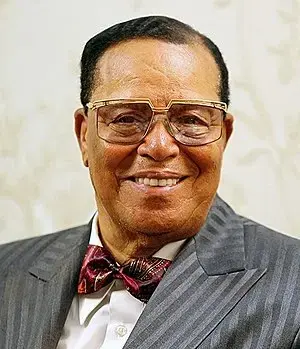
Louis Farrakhan
Introduction
About
Date of Birth: 11th May 1933
Time of Birth: 10:50pm
Place of Birth: The Bronx, New York
Long: 71 W 00
Lat: 42 N 0
Time Zone: GMT 4
Ascendant: 28 Sagittarius 07
Sun-Sign: 20 Taurus 55
Moon-Sign: 22 Sagittarius 14
LOUIS FARRAKHAN
(BORN LOUIS EUGENE WALCOTT)
Louis Farrakhan, born Louis Eugene Walcott on May 11, 1933, in The Bronx, New York City, is an influential African-American religious leader, musician, and political activist. Known for his long-standing leadership of the Nation of Islam (NOI), Farrakhan has been a controversial and compelling figure in American religious and political life since the mid-20th century.
He was born to Sarah Mae Manning, a native of Saint Kitts, and Percival Clark, a Jamaican. His parents were immigrants from the Anglo-Caribbean, and their relationship ended before Louis was born. Raised by his mother and later taking the surname of Louis Walcott, a man his mother was involved with after separating from Percival Clark, young Louis grew up without knowing his biological father. In a 1996 interview with scholar Henry Louis Gates Jr., Farrakhan speculated that his father—described as a light-skinned Jamaican with straight hair—may have had Jewish ancestry.
After the death of his stepfather in 1936, the family relocated to Roxbury, a predominantly African-American neighborhood in Boston, Massachusetts, where he spent most of his childhood. From a young age, Walcott showed exceptional talent in music. He began playing the violin at age five and, by twelve, had toured with the Boston College Orchestra. A year later, he was winning national competitions and in 1946 appeared on the Ted Mack Original Amateur Hour, one of the earliest Black performers to do so. His family were active members of St. Cyprian’s Episcopal Church in Roxbury.
He was educated at the Boston Latin School and graduated from the English High School. He went on to attend Winston-Salem Teachers College in North Carolina, where he studied for three years before leaving in 1953 to marry Betsy Ross (later known as Khadijah Farrakhan). He left school to care for her during a complicated pregnancy, marking a decisive shift from academic aspirations to family responsibilities.
In the early 1950s, Walcott launched a career in music as a calypso singer, performing under the stage name “The Charmer.” He gained popularity in the northeastern United States and Canada, especially Montreal, where he also used the nickname “Calypso Gene.” Earning a substantial weekly income, he released a series of humorous and sometimes provocative calypso songs, such as “Ugly Woman,” “Zombie Jamboree,” and “Don't Touch Me Nylon.” These tracks reflected the playful and daring nature of the Caribbean calypso tradition, though some, like “Female Boxer” and “Is She Is, or Is She Ain’t,” revealed attitudes that would later contrast sharply with his religious path.
In 1955, while headlining a calypso show in Chicago, he encountered the teachings of the Nation of Islam through saxophonist Rodney Smith, a fellow Bostonian. Intrigued, he and his wife attended Saviours’ Day, the Nation’s annual convention, where they heard Elijah Muhammad, the spiritual leader of the NOI. Previously unaware of Elijah Muhammad—like many, Farrakhan believed Malcolm X was the organization’s leader—he became deeply moved by the experience.
Farrakhan quickly immersed himself in the teachings of the Nation. He fulfilled the requirements to become a registered Muslim by memorizing the 10 questions and answers of the NOI’s Student Enrollment and submitting a Saviour’s Letter, a prerequisite for formal membership. At Elijah Muhammad's request, he ended his career as a calypso singer, fully dedicating himself to religious work. In addition to his work in the NOI, Farrakhan returned to music in the 1990s, this time as a classical violinist. Encouraged by renowned musician Sylvia Olden Lee, Farrakhan made his concert debut in 1993 with a performance of Mendelssohn’s Violin Concerto in E Minor. Though technically imperfect, critics praised his passionate and rich tone. In 2021, at the age of 88, he performed Beethoven’s Violin Concerto in D Major, Op. 61 with the New World Symphony, commemorating Beethoven’s 250th birthday. Louis Farrakhan’s life has been a blend of spiritual devotion, political activism, and artistic expression, marked by profound transformations—from charismatic entertainer to fiery preacher and violin virtuoso. He remains a complex and polarizing figure in American public life.
Raphael Ernest Grail Armattoe
Raphael Ernest Grail Armattoe, born on August 12, 1913, in Keta, Volta Region of Ghana, was a distinguished scientist, physician, poet, and political activist. Educated in Europe, he excelled in medicine, anthropology, and linguistics, gaining international recognition for his research and humanist ideals. Armattoe was a strong advocate for African unity, particularly concerned with the rights and identity of the Ewe people. He challenged colonial rule and promoted scientific development as a path to African empowerment. A Nobel Peace Prize nominee in 1948, his sudden death in 1953 remains controversial. His legacy continues to inspire African intellectual and political thought.
Cheikh Anta Diop
Cheikh Anta Diop was a fearless scholar, a visionary who reclaimed Africa’s past to inspire its future. Through science, history, and unwavering truth, he shattered colonial lies and restored the dignity of Black civilization. A son of Senegal, he proved that ancient Egypt was African, that language, culture, and intellect flourished on the continent long before colonization. His life’s work was a beacon of knowledge, resistance, and Pan-African pride. Diop’s legacy lives on in every mind awakened, in every nation that seeks its roots. He was not just a historian—he was the architect of African renaissance.
Louis Farakhan
Astro-Analysis

Louis Farrakhan
The Prophet of Transformation
An Astrological and Biographical Profile
His life controversial, charismatic, and uncompromising has been marked by a singular purpose: to defend the dignity of the oppressed, challenge authority, and speak boldly of divine justice. This profile weaves together the cosmic signatures of his birth chart with key themes in his public life, painting a picture of a man born to confront, transform, and resurrect the hidden power of his people.
1. Sagittarius Rising: The Preacher’s Gait, The Prophet’s Gaze
Louis Farrakhan’s Ascendant at 28° Sagittarius immediately signals a man on a mission. Sagittarius rising imbues him with vision, spiritual hunger, and moral certainty. People born with this Ascendant often feel called not merely to live but to teach, challenge, and uplift others through higher knowledge. They carry the air of the pilgrim, philosopher, and preacher. His rising sign places Jupiter, the planet of wisdom and expansion, as the chart ruler, emphasizing truth-seeking, intellectual authority, and ideological influence as the dominant themes of his life journey. This is the man who commands the pulpit, not only to speak, but to proclaim.
2. Chart Ruler Jupiter in Virgo, in the 8th House: The Critic and Healer of Power
Farrakhan’s Jupiter is placed in Virgo in the 8th house, a position that defines much of his public character. Jupiter in Virgo merges expansive philosophical insight with meticulous criticism. In the 8th house the realm of shared resources, hidden truths, and psychological death and rebirth Jupiter becomes the analytical surgeon of social decay.
This is a powerful indicator of his obsessive critique of institutions, his exposure of historical wrongs, and his deep engagement with power dynamics, race, death, and spiritual resurrection. Virgo’s drive for purification and reform gives Farrakhan the sharpness of a moral diagnostician, and the 8th house placement turns him into a transformational teacher, using truth as his scalpel.
Jupiter’s trine to his Taurus Sun forms a powerful Earth trine grounded, practical, and unstoppable. The Sun-Jupiter trine is one of moral purpose and enduring optimism. His ambitions are not fleeting; they are rooted in substance and legacy.
3. The Virgo 8th House Stellium: Mars, Neptune, Jupiter, and South Node
Clustered around Jupiter in the 8th house are Mars, Neptune, and the South Node, forming a powerful stellium in Virgo. Each of these planetary energies deepens the karmic and spiritual implications of his life’s mission.
Mars in Virgo brings sharp intellect and calculated courage. In the 8th house, Mars operates like a revolutionary surgeon his attacks are aimed at the rotting organs of the system.
Neptune in Virgo speaks to his mystical vision and spiritual idealism, often expressed through sacred critique. Neptune here is the dreamer of a purified world a vision often communicated through biblical and eschatological language.
The South Node signifies karmic memory what he has brought from past lives. Its placement here suggests Farrakhan is not new to spiritual warfare or ideological leadership. He may carry ancestral memories of persecution and resistance, which inform his fierce defense of Black identity and self-determination.
This Virgo stellium, placed in the house of hidden power, signals someone born to penetrate beneath the surface to expose and purify what is decaying in the moral structures of society.